
You can download the full PDF here.
30th September 2025
Hydrogen Financing Mechanisms
Department of Climate Change, Energy, the Environment and Water
Australian Government
GPO Box 3090, Canberra ACT 2601, Australia
To the Hydrogen Financing Mechanisms team,
Re: Australia-Germany H2Global Joint Tender
The Australian Hydrogen Council (AHC) welcomes the opportunity to input into the design process for the Australia-Germany H2Global Joint Tender.
The AHC is the peak body for the hydrogen and derivatives industry in Australia, and our membership includes companies from across the value chain. Our members are at the forefront of Australia’s hydrogen industry, developing the technology, skills and partnerships necessary to ensure that hydrogen and its derivatives play a meaningful role in decarbonising Australian industry.
The Australia-Germany H2Global Joint Tender (the programme) is a welcome bilateral collaboration. This €400 million mechanism aims to match Australian hydrogen supply with European customers, aiming to bridge the gap between the production cost and sales price. The AHC has been closely involved in this process, including through targeted industry consultation, the formal announcement was delivered at our 2024 conference, and our CEO was a selected reviewer in Germany earlier this year.
The AHC Secretariat met with the Australian Government and the Hydrogen Intermediary Company (HINT.CO) teams to provide initial feedback, and we use this platform to expand on these topics, namely regarding context, eligibility and responsibilities. We see the success of this programme in proving out supply chains and developing relationships for long term market objectives, and we provide the following comments in that light.
The right design for the long term
When this mechanism was first discussed, Australia had a very different hydrogen project and policy outlook. Even since the programme announcement last September, Australian projects have been increasingly focused on end uses; producing ammonia, methanol or investing in green metals or fuels.
We note that HINT.CO is likely to prioritise hydrogen for energy use and would be willing to accept hydrogen derivatives that may be cracked upon delivery. This may be misaligned with where the Australian market is strategically positioned to supply European buyers, given European options and the hydrogen backbone. While Australian projects will be producing ammonia and methanol, the issue is if H2Global presumes that cracking is required and builds those costs and complexities into the programme.
This is all the more because the Australian supply auctions require forecasting to mid-2038 in a particularly challenging and shifting nascent industry.
We also understand that Germany is looking for maximum competition in these tenders. This means maximising access. The way that this programme is currently designed is for mid-sized projects that are on the precipice of being ready. Generally, the Australian context is that we have limited mid-sized projects that are available within a short window, and more large-scale projects that will be ready further into the future. With the timeline and criteria proposed, we are concerned that this programme may not achieve the desired level of competition.
The programme needs increased flexibility
Under the proposed eligibility criteria, it appears that a project must be both early in its process and advanced enough to deliver swiftly. Any project will need to build significant risk into its application.
We have shown the timelines as proposed in the paper below in Figure 1.
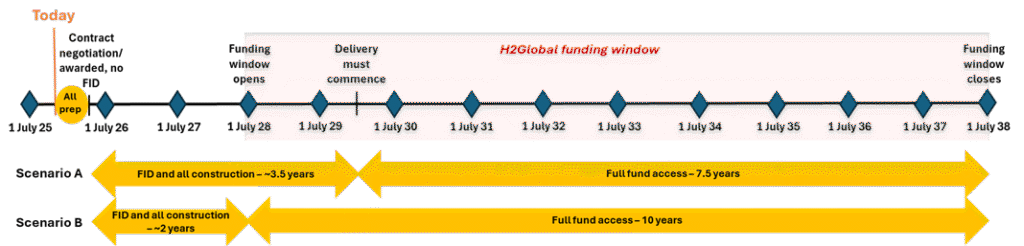
Figure 1: Indicative timelines
We note that all preparation needs to occur from now (when the rules are still being developed), to early next year. At the time of applying, a project is ineligible if it has already begun purchasing or construction, and cannot have already reached financial close.
As shown in Scenario A above, if a project maximises the time to complete FID and all construction to wait until 2031 for delivery (the latest date), it still only has around 3.5 years to undertake all of this work. Taking this approach also leaves only 7.5 years of available funding.
Alternatively, if a project was to seek to maximise funding (Scenario B), it would have at most perhaps two years to get to FID and undertake all construction.
Neither of these scenarios appear suitable to the Australian context.
While the consultation paper suggests projects can have progressed permitting, we know that some members are factoring several years (up to ten for complex supply chains) for approvals and are still not confident that the allowed time will be sufficient. This requirement will limit the eligible projects and the practical appetite to apply.
Acknowledging that the five years from contract announcement is a firm criterion, AHC recommends an extended timeline with longer application dates or extended negotiation/application processes to maximise eligibility by starting the clock later for delivery. We also suggest a longer window for the funding to apply. This makes sense not only for the window itself but because financiers prefer a 15 year tenor to 10 years.
Unlike other programs that build in flexibility to derisk uncertainty, this joint tender must factor all risk at the application stage, including exchange rates and inflation. Given the volatility of recent geopolitics and in establishing new supply chains, investors will likely be concerned with this risk profile. For the Hydrogen Headstart Round 1 process, shortlisted projects had a case manager at ARENA who received regular updates on the progress and helped mitigate challenges. Given the stage of the projects sought, there is likely to be unexpected complications and strategic shifts. We welcome the negotiation phase of the programme but recommend that this continues throughout the life of the partnership to account for project-level, domestic, or geopolitical risks.
These factors are additional to the practical or expected misalignments with domestic policies,[1] such as the EU requirements regarding additionality (which we note the German Government has argued will need to change), the emissions threshold measured in megajoules, the (currently unfinished) Community Benefit Principles (assessed by HINT.CO), the Hydrogen Headstart application timelines limiting stackability, and the delivery gate extending past the Guarantee of Origin Scheme’s jurisdiction.
These risks are likely to limit appetite for the programme, and programme design will need to consider how to address these matters.
Recommendation 1: Loosen or remove the restrictions on project progress. Commit to flexibility and maximising application appetite by allowing projects to begin progressing (within reason) prior to application.
Recommendation 2: Shift the Australia-Germany H2Global Joint Tender timeline to increase eligibility. Through the negotiation phase, develop the ideal timeline to best align with project delivery. This may require a delayed announcement to adhere to the programme’s five-year delivery window.
Recommendation 3: Increase the eligible funding period from ten to fifteen years. To help secure private financing, the offtake agreement should be extended to fifteen years.
Recommendation 4: Amend the funding window to start upon delivery. Instead of the fixed funding period (currently 2028-29 to 2037-38 inclusive), the ten (or fifteen if the above recommendation is considered) years of support should be linked to a project’s delivery date to support bankability.
Recommendation 5: Increase flexibility throughout the duration of the program. Build in flexibility or the ability to reasonably negotiate with a HINT.CO case manager to account for any unexpected delays or changes.
Who pays for undefined costs
Less clear through the consultation is the responsibility of ammonia cracking. Given the design of the separate supply and demand auctions with varying durations, there is no apparent conversation between parties on how the product will be used.
The consultation paper notes that the delivery gate within Germany is up to the bidder and may need to be near an ammonia cracker. Elsewhere, this states that the annual contract quantities can be in kilograms or megawatt hours. This is building a narrative that projects can bid in to deliver ammonia that could be bought as ammonia.
However, it is unclear who is responsible to fund the ammonia cracking if this is necessary for one or all users through the lifetime of the programme. It would be unnecessarily complex to require the buyer or seller to invest in and develop the technology and business case for an ammonia cracking facility, especially if this is in another jurisdiction. Whomever it falls to, this is expected to be a significant cost and a separate avenue of risk in a nascent technology. It will also consume a considerable amount of the programme funds as the cost gap will be extended.
As suggested earlier in this response, we would strongly recommend that the programme works to build long term supply chains. It would be concerning to waste funding on cracking when this may not be needed.[2]
Recommendation 6: Remove complexity by selling hydrogen derivatives in their delivered form. Develop long term supply chains and avoid the unnecessarily draw down on the programme funding for cracking.
Maximise support for eligible projects
The Australian Government will be aware of which projects are likely to be eligible for this programme. In the current proposed design, there may be few projects that are eligible and fewer that would choose to apply. To ensure the success of this programme, the Australian and jurisdictional governments have a role in supporting and stewarding these projects.
The Australian Government and the relevant state governments will need to wrap around the shortlisted projects to assist, coordinate and streamline processes. This includes ensuring timely approvals and permits, support in navigating regulatory compliance, but also the masterplanning of critical or common user infrastructure, such as for inputs (e.g., renewable energy projects, water, transmission upgrades) or delivery (e.g., port upgrades, availability of bunkering and low carbon shipping fuels).
It is not uncommon for a state investment vehicle or Coordinator General to support projects of national significance. To safeguard success, it would be ideal if a state government body became part of the project pitch. This endorsement would reassure all parties that barriers and bottlenecks outside of the project’s control are managed and addressed.
Recommendation 7: Develop a full wrap around service for shortlisted projects. This should include collaboration across federal, state and local governments and could require a state government body to join the supply side bid.
The potential expansion to additional hydrogen derivatives
The AHC is generally supportive of including additional hydrogen derivatives, such as low carbon liquid fuels or green metals, in the programme. This would theoretically increase the number of eligible projects and develop supply chains in alignment with the Future Made in Australia priorities. However, it is unclear if these derivatives could meet the proposed timelines.
Recommendation 8: Expand eligibility to additional hydrogen derivatives when feasible. The Australian Government should review the pipeline and timeline of hydrogen derivatives that could be included in the Australia-Germany H2Global Joint Tender or any subsequent rounds.
We are pleased to see the progress of the Australia-Germany H2Global Joint Tender and look forward to further engagement with the Australian and German governments.
If you wish to discuss any element of this submission, please contact me at [email protected].
Kind Regards,
Natasha Cerexhe
Policy Manager
Australian Hydrogen Council
APPENDIX: Comparison of funding programmes
| Hydrogen Production Tax Incentive | Headstart Headstart (Round 2) | Australia-Germany H2Global Joint Tender | |
| Minimum | 10MW | 50MW | 10MW |
| Duration (max) | 10 years | 10 years | 10 years |
| Eligible funding period | 1/7/2027 to 30/6/2040 (13 years) | To 2038-39 (currently budgeted) | 2028-29 to 2037-38 (10 years) |
| FID date | By 2030 | NA | After contract |
| Delivery date | NA | NA | By 2031 |
| Emissions intensity | 0.6g CO2e/kg (to production gate) | NA (electrolysis only) | 25.38g CO2e/MJ (production to delivery) |
| Additionality | No | No | Yes, hourly from 2030 |
| PPAs accepted | Yes, same grid | Yes | Yes, same grid |
| SMR/gasification ineligible | Yes | Yes | Yes |
| Eligible products | Hydrogen | Hydrogen and derivatives | Hydrogen, ammonia or methanol |
| Community benefit principles | Through tax system (from 2027) | Through ARENA at application (2023-26) | Through HINT.CO at application (2026) |
| Flexibility of supply | Yes | Yes, includes upside sharing | No, must factor in risk at application |
| Support type | Production credit: $2/kg | Production credit: negotiated | Guaranteed offtake and quasi-CfD model |
[1] See the Appendix for further comparison with the Hydrogen Headstart (Round 2), Hydrogen Production Tax Incentive and proposed Australia-Germany H2Global Joint Tender.
[2] See also: ATCO (2024) Window of Opportunity: Australia’s pathway to supply German hydrogen derivative demand to 2050, funded by Australian Renewable Energy Agency, May, https://arena.gov.au/assets/2024/12/ATCO-Scale-H2-Feasibility-Study-Market-Study-Report.pdf.